Table of Contents
-
- Introduction
- Why Keyword Intent Could Make or Break Your Content Strategy
- Understanding the Different Types of Keyword Intent
- How to Identify and Align Content with Keyword Intent
- Ultimate Guide to Keyword Intent Optimization Tools and Methods
- Common Mistakes to Avoid When Targeting Keyword Intent
- Conclusion
Introduction
Knowing the purpose of keywords is one of the most crucial elements of SEO success. A search query’s goal is known as keyword intent, or search intent. It makes it easier for search engines to determine what the user is actually looking for. The goal of typing “how to make a cake,” for instance, is to learn. However, if people look for “buy chocolate cake near me,” they probably want to buy.
Search engines like Google use keyword intent to deliver the most relevant results. These days, SEO is about aligning content with user intent, not simply about keywords. If you get this right, you’ll rank higher, engage more users, and increase conversions.
Understanding keyword intent is the first step toward creating a content strategy that connects with users. In this article, we’ll dive into keyword intent, explain its importance, and guide you on how to optimize for it. Additionally, we’ll discuss methods for determining keyword intent and tailoring material to it.
Why is this important for SEO?
Your chances of raising your ranks on search engine results pages (SERPs) are significantly higher when your content is in line with keyword intent. Furthermore, this alignment leads to higher engagement rates, better user satisfaction, and ultimately, improved conversion rates. By targeting the right type of intent, you can guide users through their journey, whether they are just learning about a topic or ready to make a purchase.
In this blog, we’ll dive deeper into the concept of keyword intent, explore the types of intent, and provide strategies to help you optimize your SEO by aligning your content with what users are searching for. You’ll also learn how to identify keyword intent, how to tailor your content accordingly, and how to avoid common mistakes that can hurt your rankings.
Why Keyword Intent Could Make or Break Your Content Strategy
Modern SEO is centered on keyword intent. A user’s search is motivated by it. You may produce content that satisfies people’ demands by understanding purpose. Search engines like Google care more about intent than individual keywords. Google aims to provide results that satisfy what users are looking for. Your chances of ranking better and being viewed by the appropriate audience are increased when your material is in line with your goal.
User Experience & SEO
A great user experience is essential for SEO. If your content matches user intent, visitors will stay longer. They’ll interact with your content and come back for more. Google notices these actions and rewards your site with better rankings. On the other hand, if your content doesn’t align with the search intent, users leave quickly, and your rankings will drop.
Google’s Algorithm Evolution
Google’s algorithms, like RankBrain and BERT, focus on understanding intent. AI is used, for instance, by RankBrain to decipher the meaning of a search query. This enables Google to display results even when the precise term is missing. Google’s shift towards understanding intent instead of just keywords means SEO now focuses on context. By optimizing for intent, you are giving Google the signals it needs to rank your content higher.
Search Engine Result Pages (SERPs)
Different kinds of search intent produce different kinds of SERP results. As an illustration:
-
-
- Informational intent results in blogs, articles, and FAQs.
- Transactional intent results in product pages or service listings.
- Navigational intent results in specific brand pages or homepages.
-
There are distinct search results for each sort of purpose. You can better design content that aligns with these outcomes if you understand this. You’re more likely to rank highly if you share the same goals.
Conversion Optimization
Conversions are one of the primary objectives of SEO. Whether it’s a sale, sign-up, or download, your content must be optimized for the right intent. For example, if your keyword indicates transactional intent, your page should focus on buying the product, with clear CTAs like “Buy Now.” For informational intent, you can provide helpful content with educational value.
Users may more easily accomplish their objectives when your content is in line with the intent of your keywords. This increases the likelihood of them completing an action on your site, which boosts your conversion rate.
Understanding User Needs
The user’s trip status is indicated by their goal. A few are prepared to purchase, while others are only seeking information. If you know where they are, you can make material that is appropriate for them.
For example:
-
-
- The user’s goal is to learn something, such as “how to change a tire.”
- Commercial Intent: Before making a purchase, the consumer is weighing their alternatives (e.g., “best laptops 2025”).
- Transactional Intent: The user is ready to buy (e.g., “buy Apple MacBook Pro”).
-
By identifying what stage the user is at, you can create content that helps them move to the next step. This could be providing an informative article, a product comparison, or a call to action to purchase.
The sorts of keyword intent will be covered in detail in the next section. We’ll examine each intent type in detail and talk about how to tailor content to each one. Watch this space!
Understanding the Different Types of Keyword Intent
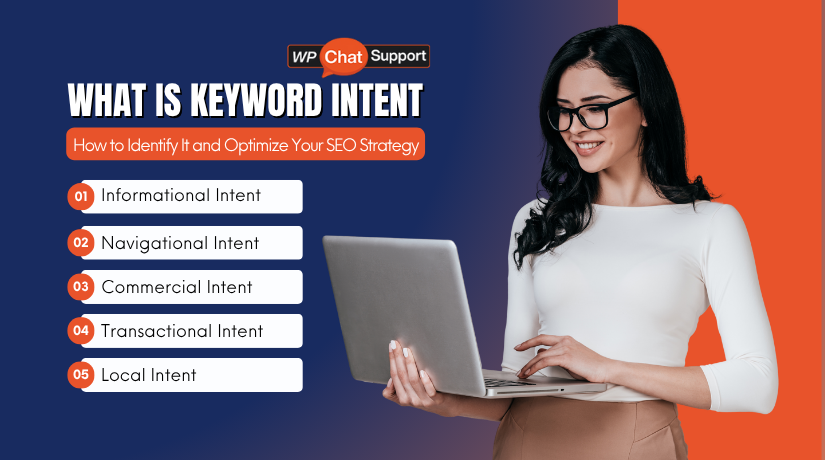
It’s crucial to comprehend the various forms of keyword intent in order to produce user-friendly content. A user’s search query’s purpose is known as its keyword intent. Keyword purpose may be classified into many categories, such as transactional, commercial, navigational, informative, and local. You may adjust your material to the user’s wants and increase your chances of ranking better by understanding their aim. This section will discuss the various kinds of keyword intent and how to tailor content to them.
#1 Informational Intent
Informational intent is the most common type of search query. When users search with informational intent, they are looking for answers to specific questions or learning more about a topic. These users are not immediately interested in purchasing anything. Their goal is to acquire information or comprehension.
Examples of Informational Intent Searches:
-
-
- “How to start a blog”
- “What is SEO?”
- “Best practices for email marketing”
- “How do clouds form?”
-
Features of Informational Intent
-
-
- User Goal: The user wants particular information or to learn something.
- Search Query: Informational searches frequently contain terms like “what is,” “how to,” “guide,” or “tips.”
- Content Type: Ideal content for informational intent includes blog posts, tutorials, how-to guides, and FAQs.
-
Optimization Tips for Informational Intent
-
-
- Provide In-Depth Content: Create long, detailed articles that thoroughly answer users’ questions. Provide examples and practical advice to keep users engaged.
- Organize Your Content: Utilise bullet points, subheadings, and headings to divide the material. This facilitates reading.
- Use Multimedia: Include images, infographics, or videos to help explain complex topics. User comprehension and engagement can be enhanced via multimedia.
- Optimize for Featured Snippets: Organise your material to succinctly and clearly address particular questions. This makes it more likely to show up in Google’s highlighted snippets.
-
#2 Navigational Intent
Users who are looking for a certain website or page are said to have navigational purpose. Although the precise URL may be unknown to them, they are aware of the website they wish to visit. This type of intent is typical for users who want to go directly to a specific brand, platform, or service.
Examples of Navigational Intent Searches
-
-
- “Facebook login”
- “YouTube homepage”
- “Amazon shopping cart”
- “CNN news”
-
Features of Navigational Intent
-
-
- User Goal: The user wants to visit a certain website or locate a certain page.
- Search Query: Often includes the brand name or specific web address (e.g., “Facebook,” “YouTube,” “Amazon”).
- Content Type: Content types for navigational intent include homepages, login pages, and brand-specific landing pages.
-
Optimization Tips for Navigational Intent
-
-
- Make Your Brand Easily Findable: When consumers search for your brand, make sure your website shows up in the results. This will assist in bringing visitors to your website immediately.
- Optimize Your Homepage: Your homepage should be clean, simple, and easy to navigate. Ensure that key information is visible and accessible.
- Fix Broken Links: Verify whether any connections are broken. Consumers anticipate having instant access to the site they desire.
- Improve Your Site’s Loading Speed: A quick website will assist maintain user interest. Pages that load slowly might have a high bounce rate, which lowers your ranks.
-
#3 Commercial Investigation
Consumers who are investigating goods or services before making a choice are engaging in commercial investigation intent. These people are interested in learning more about their alternatives but are not yet ready to make a purchase. Their decision-making process may involve reading reviews or comparing items.
Examples of Commercial Investigation Searches:
-
-
- “Best smartphones 2025”
- “Top digital cameras under $500”
- “Best accounting software for small businesses”
- “Review of iPhone 14 Pro”
-
Features of Commercial Investigation Intent
-
-
- User Goal: The user is researching or comparing products or services to help them decide what to buy.
- Search Query: Often contains phrases like “best,” “top,” “reviews,” or “compare.”
- Content Type: Product reviews, comparison articles, and buying guides are ideal for commercial investigation queries.
-
Optimization Tips for Commercial Investigation Intent
-
-
- Detailed Product Reviews: Create in-depth reviews that cover the features, pros, cons, and pricing of the products. Provide real-world use cases.
- Comparison Pages: Provide tables or charts that allow users to quickly compare various goods or services. Users will find it simpler to locate the ideal option as a result.
- Include Trust Signals: Use testimonials, ratings, and reviews from customers to establish credibility. Demonstrate that other people have used your product successfully.
- Provide Clear Next Steps: Use calls to action that are obvious to help consumers decide. Encourage them to buy the product, sign up for updates, or even do additional research on it.
-
#4 Transactional Intent
Users who are prepared to buy something or finish a certain task are said to have transactional intent. When customers have transactional intent, they are often nearing the end of the buyer’s journey and want to do something, like download something, join up for a service, or purchase a product.
Examples of Transactional Intent Searches
-
-
- “Buy iPhone 14 Pro”
- “Download Adobe Photoshop”
- “Order pizza online”
- “Sign up for newsletter”
-
Features of Transactional Intent
-
-
- User Goal: The user is ready to take action, such as making a purchase or signing up for something.
- Search Query: Phrases like “buy,” “purchase,” “order,” “subscribe,” or “download” are common for transactional searches.
- Content Type: Product pages, service pages, checkout pages, and subscription pages are ideal for transactional intent.
-
Optimization Tips for Transactional Intent
-
-
- Clear Calls to Action: Use strong and persuasive CTAs like “Buy Now,” “Order Today,” or “Subscribe Now” to guide users toward completing the action.
- Smooth Checkout Process: Make the buying process as simple as possible. Offer multiple payment options and ensure the process is quick and secure.
- Highlight Benefits: Focus on the benefits of the product or service. Show why users should act now.
- Incorporate Social Proof: Include customer reviews, trust badges, and product ratings to help users feel confident in their purchase.
-
#5 Local Intent
Searching for goods or services close to where they are now is known as local purpose. For companies that have a physical location, such restaurants, shops, or service providers, this kind of search is quite typical.
Examples of Local Intent Searches:
-
-
- “Coffee shop near me”
- “Plumber in Chicago”
- “Best sushi in New York”
- “Pizza delivery in Los Angeles”
-
Features of Local Intent
-
-
- User Goal: The user is looking for businesses, services, or products that are geographically close to them.
- Search Query: These searches often include location-specific terms like “near me,” or city names.
- Content Type: Business listings, Google My Business pages, and location-specific service pages are ideal for local intent.
-
Optimization Tips for Local Intent
-
-
- Claim Your Google My Business Listing: Make sure Google My Business has a listing and verification for your company. This is essential if you want to show up in local search results.
- Use Local Keywords: Make sure your content, meta tags, and page URLs contain location-specific keywords.
- Optimize for Mobile: Local searches are often performed on mobile devices. Make sure your website is mobile-friendly and loads quickly.
- Encourage Local Reviews: Request evaluations from pleased clients on review sites like Google. Having good ratings increases your local rankings and fosters confidence with prospective clients.
-
How to Identify and Align Content with Keyword Intent
To optimise your content, you must determine the purpose of your keywords. You may adjust your material to the user’s demands after you understand the intent behind the search query. To successfully determine keyword intent, use these steps:
Examine Search Query Language
The language used in a search query is the first clue to understanding intent. By looking at certain keywords, you can determine whether the searcher is looking for information, planning to buy something, or looking to visit a website. Here’s how you can break it down:
-
-
- Action-Based Words: Words like “buy,” “purchase,” and “order” signal transactional intent, meaning the user is likely ready to make a purchase.
- Informational Words: Phrases like “learn,” “how to,” and “what is” show that the user is searching for information or answers to questions. This suggests informational intent.
- Comparative Words: Words like “best,” “top-rated,” or “compare” indicate commercial investigation intent, where the user is comparing options before making a decision.
- Navigational Words: Searches like “login” or “visit” usually point to navigational intent, where the user is looking to go to a specific website or page.
-
By analyzing these terms, you can start categorizing the keyword’s intent and plan your content accordingly.
Evaluate Search Engine Results (SERPs)
Another great way to understand keyword intent is by looking at the search engine results. Google shows different types of content depending on the intent behind the search. Here’s how you can evaluate it:
-
-
- Informational Intent: If you see blog posts, articles, tutorials, and FAQs in the results, the intent is likely informational. Users want to learn something.
- Transactional Intent: If you see product pages, shopping sites, or checkout pages in the results, the intent is transactional. Users are ready to make a purchase.
- Navigational Intent: If branded websites, login pages, or specific landing pages appear in the results, the user likely wants to visit a particular website.
- Commercial Investigation Intent: When buyer’s guides, review websites, and comparison pages predominate in the results, the user is looking into goods or services before making a purchase.
-
By examining the content types that rank for a keyword, you can easily determine the intent.
Look at User Behavior
Understanding how users interact with your content can also help identify keyword intent. Certain behaviors indicate whether your content matches their needs:
-
-
- Bounce Rate: Users may not be finding what they’re looking for if they land on your page and then immediately leave. A high bounce rate indicates that users aren’t finding your material to be helpful.
- Time on Page:Users that stay on your page for extended periods of time are likely finding value in your material. For informational queries, long-form content with thorough explanations can keep users engaged.
- Click-through Rate (CTR): If your page ranks for a keyword but has a low CTR, it may mean your content doesn’t align with the user’s expectations. You can adjust the title or meta description to better match the keyword intent.
-
The degree to which your material satisfies keyword intent can be better understood by monitoring certain user behaviour data.
Use Keyword Research Tools
Using SEO tools like SEMrush, Ahrefs, and Google Keyword Planner is a smart way to identify keyword intent. Data on search traffic, competitiveness, and related terms are provided by these tools. This is how they may assist:
-
-
- Search Volume: High-volume keywords with specific queries like “buy now” often have transactional intent.
- Competition Level: If the competition is high for a keyword, it may indicate a commercial or transactional intent. This is because many businesses are targeting that search term.
- Related Keywords: Keyword research tools show you related search queries. These related terms can help you understand whether a user is looking for more information or is ready to make a purchase.
-
These tools simplify the process of identifying intent by showing data that correlates with the type of content users are searching for.
Search Volume and Trend Analysis
Analyzing the search volume and trends for a specific keyword can also shed light on keyword intent. A keyword with high search volume during certain times of the year might indicate that users are more interested in making a purchase or looking for specific information during those months. Tools like Google Trends can help you see if interest in a keyword is increasing or declining.
For example, keywords related to “best Christmas gifts” will have higher search volume closer to the holiday season. This means users are likely performing commercial investigation. Monitoring these trends allows you to optimize content based on user behavior over time.
Competitor Analysis
Looking at your competitors is another way to identify keyword intent. By reviewing the content that ranks for your target keywords, you can understand how competitors are addressing the search query. Here’s how you can perform competitor analysis:
-
-
- Content Type: Are competitors using product pages, blogs, or videos? This can tell you the type of content needed to meet keyword intent.
- Content Gaps: Look for areas where competitors’ content is lacking. If they haven’t fully addressed a specific aspect of user intent, you can create better content to fill that gap.
-
Competitor analysis helps you spot trends and opportunities, giving you a competitive edge in aligning your content with user intent.
Ultimate Guide to Keyword Intent Optimization Tools and Methods
Improving the SEO performance of your website requires optimising the purpose of your keywords. You can discern user intent and modify your content accordingly with the aid of a number of tools and strategies. Let’s examine the primary resources and techniques for improving your keyword intent.
List Of Keyword Research Tools
Tools for doing keyword research are the foundation of every SEO approach. These tools support you in determining the intent of your keywords and help you tailor your content to the demands of your audience.
#1 SEMrush
For thorough keyword research, SEMrush is among the greatest resources. It offers comprehensive data on keyword volume, competitiveness, and intent. The “Keyword Magic Tool,” which SEMrush offers, assists in locating long-tail and short-tail keywords that correspond to various search intentions.
How to Use SEMrush for Intent:
-
-
- Use the “Keyword Overview” feature to learn about keyword intent. This tool shows which type of content ranks for a keyword.
- Analyze the SERP features, such as featured snippets or answer boxes, which can indicate informational or transactional intent.
- Look at the search volume and trend analysis to understand if the intent is commercial or informational.
-
#2 Ahrefs
Another effective tool for keyword research is Ahrefs. It provides information about keyword intent by displaying the pages that rank for particular keywords. The kinds of material that appeal to users’ intent are shown by Ahrefs.
How to Use Ahrefs for Intent
-
-
- Use Ahrefs’ Keywords Explorer to analyze the intent behind specific keywords. Look at which pages rank and what content formats they use.
- Use the SERP Overview to check the content types (e.g., blogs, videos, or product pages) ranking for a keyword.
-
#3 Google Keyword Planner
Though it doesn’t express meaning clearly, Google’s free tool is excellent for finding possible phrases. However, by examining search traffic and similar searches, you may still infer it.
How to Use Google Keyword Planner for Intent:
-
-
- Focus on low-competition keywords that align with a specific intent. These keywords often indicate a strong user need.
- Look at the related search queries and use those to identify more specific intents that your content can target.
-
List of Content Gap Analysis Tools
Content gap analysis is a technique used to find missing content on your website. By identifying what competitors are ranking for, you can spot gaps in your content and optimize it for the right keyword intent.
SEMrush, Ahrefs, and Moz all provide tools for content gap analysis. These tools help you compare your website with competitors and discover areas where your content does not align with keyword intent.
How to Use Content Gap Analysis for Intent:
-
-
- Use tools like SEMrush’s Content Gap Tool to identify keywords your competitors rank for but you don’t.
- Look for keywords with a clear intent that competitors have covered but you haven’t addressed. This will help you fill the content gap and match user intent.
- Compare SERP features for each competitor’s ranking page and determine the intent behind the keyword they are targeting.
-
Common Mistakes to Avoid When Targeting Keyword Intent
When optimizing for keyword intent, avoiding common mistakes can help improve your rankings and keep your content aligned with what users are searching for. Let’s look at the most common mistakes and how to avoid them.
Ignoring Search Intent
One of the biggest mistakes is ignoring the user’s search intent. If your content doesn’t meet the need behind the query, users will quickly leave your page. This results in high bounce rates and low engagement.
How to Avoid It
-
-
- Always ensure that your content matches the user’s goal—whether it’s to learn, compare, buy, or find a service.
- Focus on the user’s perspective when creating content to ensure relevance.
-
Overusing Keywords (Keyword Stuffing)
Keyword stuffing is the practice of overloading content with keywords in an unnatural way. This hurts both user experience and SEO performance, as Google may penalize you for spammy content.
How to Avoid It
-
-
- Incorporate keywords organically into your writing. Don’t say them too many times.
- Make an effort to produce useful, educational information that answers the search question.
-
Failing to Update Content
SEO is ever-evolving, and so is keyword intent. If you don’t regularly update your content, it may no longer align with current user intent or search trends.
How to Avoid It
-
-
- Regularly update old content to ensure it remains relevant and accurate.
- Use tools like Google Trends to monitor any changes in keyword behavior or user interest.
-
Overlooking Mobile Optimization
Mobile devices are currently used by a sizable percentage of consumers to view websites. Your content may be losing significant visitors if it is not optimised for mobile devices.
How to Avoid It
-
-
- In order for your content to function properly across desktops, tablets, and smartphones, it must be fully responsive.
- Check the functionality of your website on mobile devices using Google’s Mobile-Friendly Test tool.
-
Not Optimizing for Featured Snippets
Search results’ valuable real estate is comprised of featured snippets. You are losing a great chance to get noticed in the search engine results pages if your material is not optimized for them.
How to Avoid It
-
-
- Structure your content in a way that makes it easy for Google to extract a snippet. Use question-based headings, bullet points, and direct answers.
- Focus on providing concise, actionable information that directly answers a query.
-
Focusing Only on Volume
Targeting high-volume keywords without considering intent can attract the wrong audience. It’s more important to target keywords with clear, relevant intent rather than just focusing on volume.
How to Avoid It
-
-
- Combine search volume with keyword intent to target keywords that will bring the right traffic.
- Look for long-tail keywords that are specific and show a clear intent, even if the volume is lower.
-
Conclusion
Gaining an understanding of keyword intent is essential for SEO success. Finding keywords isn’t enough; you also need to know why people are searching for them. The purpose of the user’s search is referred to as keyword intent. Aligning your content with their aim is essential to improving your search engine ranking, regardless of whether they are searching for information, a product, or a service.
Making use of the appropriate tools is crucial. Tools like as Google Keyword Planner, Ahrefs, and SEMrush aid in determining the user’s intent. With the help of these technologies, you may learn what people are actually searching for. You may produce material that responds to their queries or fulfils their wants by examining search queries.
It’s also critical to monitor user behaviour. To see how users engage with your content, use tools such as heatmaps or Google Analytics. You may then determine whether your material is meeting their needs and make the required improvements.
Steer clear of typical blunders as well. Your SEO performance may suffer if you overuse keywords, ignore mobile optimisation, and stop updating outdated material. By matching content to your audience’s search intent, you can always concentrate on giving them something of value.
In summary, the most efficient method of generating relevant traffic is to optimise for keyword intent. It improves rankings, raises conversion rates, and increases engagement. Maintaining your competitiveness in the always changing SEO landscape requires you to regularly analyse and modify your content strategy to align with user intent.